countertops
Countertop Edge Profiles: A Guide for Your Kitchen
See the most common countertop edge styles, from eased to waterfall, and learn how to pick the right one for your kitchen's look and budget.
In this guide
The edge profile is one of the last decisions homeowners make on a countertop project, and one of the most overlooked. It's a small detail with an outsized effect: the same slab can look sleek and modern or warm and traditional depending on how the front edge is cut. Here's a rundown of the most common edge profiles and how to think about choosing one.
Eased Edge
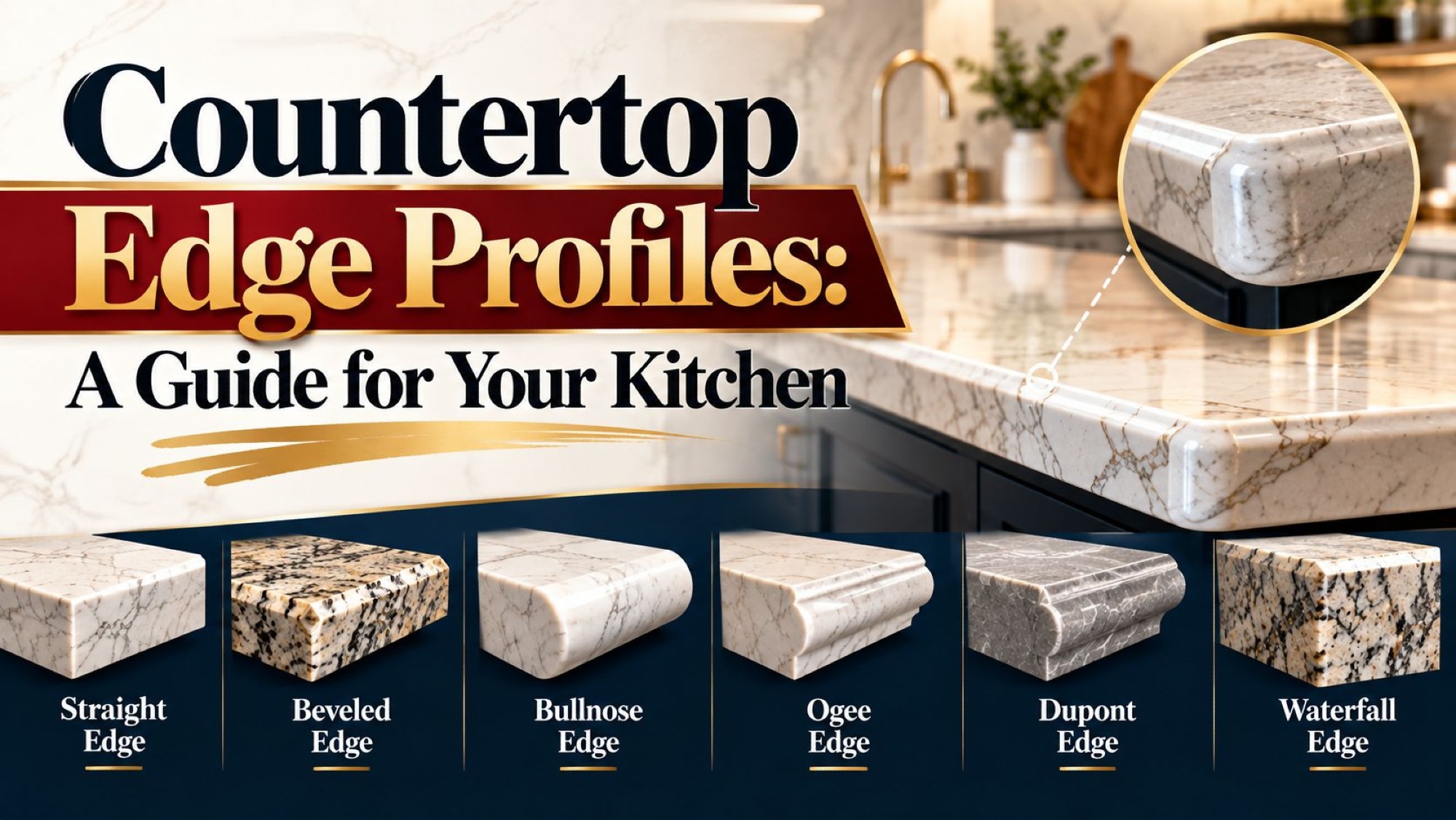
An eased edge has a slightly softened corner instead of a completely sharp 90-degree line. It's a clean, understated look that works with almost any kitchen style, and it's typically the simplest edge to fabricate, which keeps it budget-friendly.
Beveled Edge
A beveled edge is cut at a 45-degree angle along the top, creating a crisp, faceted line where the edge meets the surface. It adds a bit of geometric detail without being ornate, and it reads as clean and contemporary.
Half Bullnose and Full Bullnose
A half bullnose rounds the top of the edge while keeping the bottom flat, giving a gentle curve without a fully rounded look. A full bullnose rounds the entire edge on both the top and bottom, producing a soft, traditional profile. Bullnose edges are also a practical choice for households with young children, since there's no hard corner to catch on.
Ogee Edge
An ogee edge cuts a flowing S-curve into the stone, alternating between concave and convex. It's one of the more decorative, traditional profiles and tends to suit classic or formal kitchen designs rather than minimalist ones.
Dupont Edge
A Dupont edge starts with a straight vertical drop before curving outward toward the bottom, giving a more architectural, layered look than a simple bullnose. It's a less common choice, which can make it a distinctive option if you want something outside the standard eased-or-bullnose default.
Mitered (Waterfall) Edge
A mitered edge joins two pieces of stone at a 45-degree angle so the seam is hidden, making the countertop appear thicker than the slab actually is. This is the technique behind waterfall islands, where the stone wraps over the edge and continues straight down the side of the cabinetry for a single, continuous look.
Cove Edge
A cove edge curves inward rather than outward, creating a smooth concave detail along the underside of the edge. It's a subtler, more refined transition than a bullnose and shows up most often on higher-end traditional designs.
Chiseled Edge
A chiseled edge leaves the stone's natural, unpolished texture along the front, giving it a rustic, organic look. It's most common on granite and other natural stones where the goal is to highlight the material's raw character rather than a smooth, finished line.
How to Choose the Right Edge for Your Kitchen
Start with your overall kitchen style. A simple eased or beveled edge tends to suit modern, minimalist kitchens, while bullnose, ogee, and cove edges lean traditional. From there, think about daily use: households with kids or a lot of foot traffic around the counter often lean toward a rounded edge for safety, while a more decorative edge like ogee or Dupont makes the most sense in a lower-traffic area like an island used mainly for display. Edge complexity also affects fabrication time and cost, since a simple eased edge takes less shop time than a hand-detailed ogee or a mitered waterfall join, so it's worth discussing your options against your budget before you finalize your slab order.
Pairing Your Edge With the Right Material
Some edges show off certain materials better than others. Dramatic veining, common in granite and quartzite, tends to stand out on a simple eased or beveled edge that doesn't compete with the pattern, while a uniform quartz surface can carry a more decorative profile like an ogee without looking busy. Bring your cabinet finish into the conversation too — you can browse our current cabinet styles alongside your material and edge choice to see how the whole kitchen comes together.
See Edge Samples in Person
Edge profiles are hard to judge from a photo, since the way light catches a curve or bevel changes a lot depending on the angle. The best way to decide is to see physical samples against your chosen material. Our team can walk you through the options that fit your project and budget during a free design consultation, and you can learn more about how our full process works on our Services page.
Ready to Choose Your Edge?
Book your free design consultation or schedule a free in-home measurement, and we'll help you pick an edge profile that fits your kitchen and your budget. Visit our showroom at 6555 Jimmy Carter Blvd, Norcross, GA, or call (770) 441-1681 to get started.
Frequently Asked Questions
Does the edge profile change the price of my countertop?
Yes, more detailed edges generally take more shop time to fabricate, so a simple eased edge typically costs less than a hand-shaped profile like an ogee or a mitered waterfall join. Ask for specifics during your free design consultation.
What edge is safest for a kitchen with young children?
A half or full bullnose edge removes sharp corners entirely and is a common choice for family kitchens for that reason.
Can I mix edge profiles in the same kitchen?
It's possible, though most homeowners choose one consistent profile for the main countertop and island. Our team can help you decide whether a mixed approach makes sense for your layout.
Planning a countertop project?
See the materials in person.
Visit our Norcross showroom or request a consultation with the UCI Kitchen & Bath team.